How do we find our limit?
For my first ever bike race, it's fair to say that I went in all-guns-blazing and right off the deep end by choosing to take on what is widely considered the toughest cycling race on the planet.
At 40% longer than the Tour De France, with more elevation, in fewer days and without the support of mechanics, chefs, hotels or rest etc, the Transcontinental Race (TCR) is an annual, self-supporting, ultra-distance bicycle race across Europe. It's roughly 3,000 miles/5,000km of racing, with this year's edition starting in Trondheim, Norway, and finishing in Kalamata, Greece. Riders had 20 days or under to finish in the official time, with this year's winner completing it in just over 10 days! Spoiler alert: it wasn't me (almost 50% of the field didn't even finish!)
There are four mandatory checkpoints riders must reach within a time limit, and these are usually preceded by a compulsory Parcours of roughly 100 miles, designed by the race organisers to be "challenging", although I would soon discover that their idea of challenging is closer to my definition of dangerously unsafe.
Aside from those rules, riders are expected to be entirely self-sufficient, from sourcing food and drink to accommodation and route planning. You're not even allowed to share food or provide assistance to riders, a rule I found slightly at odds with the community message pushed by the organisation.
My first challenge was simply getting to Trondheim. Norwegian Airlines flew my bike up in a well-packed box, but somehow still managed to break my rear derailleur, meaning I had a non-functional bike. Thankfully, with the help of a local bike shop, I was able to set off at 8 pm on the 19th July, alongside 400 other intrepid cyclists; but not before a bout of food poisoning the night before just for good measure. The signs were already ominous...
The first mistake:
The 8 pm start combined with 24 hours of daylight in northern Norway meant the 170-mile Start Parcours could be ridden in one go. This was my original plan. I even found myself in a surprisingly high 32nd place after a few hours (unbeknownst to me at the time) as I cruised along quiet Norwegian roads and valleys, large cliffs looming over quaint wooden houses and neatly mowed fields. Cool air rushed past as I pedalled along with a sense of fear, excitement and anticipation of what lay ahead over the next three weeks. I couldn't see any other riders and so assumed I was near the back of the pack, but was content to pedal along at my own pace. I had to stop every now and then to make minor adjustments to my saddle and gears as they settled after the emergency repairs, but overall it was fairly easy going.

By 3 am, however, the temperature had fallen to -4c. In July! It was well below anything I'd prepared for. Even with every layer on, I was shivering on the bike. I made the decision to stop and sleep to stay warm, setting up my sleeping bag (only rated to 5c) and bivvy bag in a ladies' toilet block (someone had already claimed the men's). Needless to say, I didn't sleep. Worse still, I was passed by most of the field, and crucially, my knees seized up from the cold.
It was painful getting back on the bike, and now at the back of the group, I faced a constant battle of not only trying to catch up, but finding empty shops and fully booked accommodation for the next 300 miles. And all the while having the pressure of the dot watchers overlooking me, judging my progress and lack of coherent tactics.
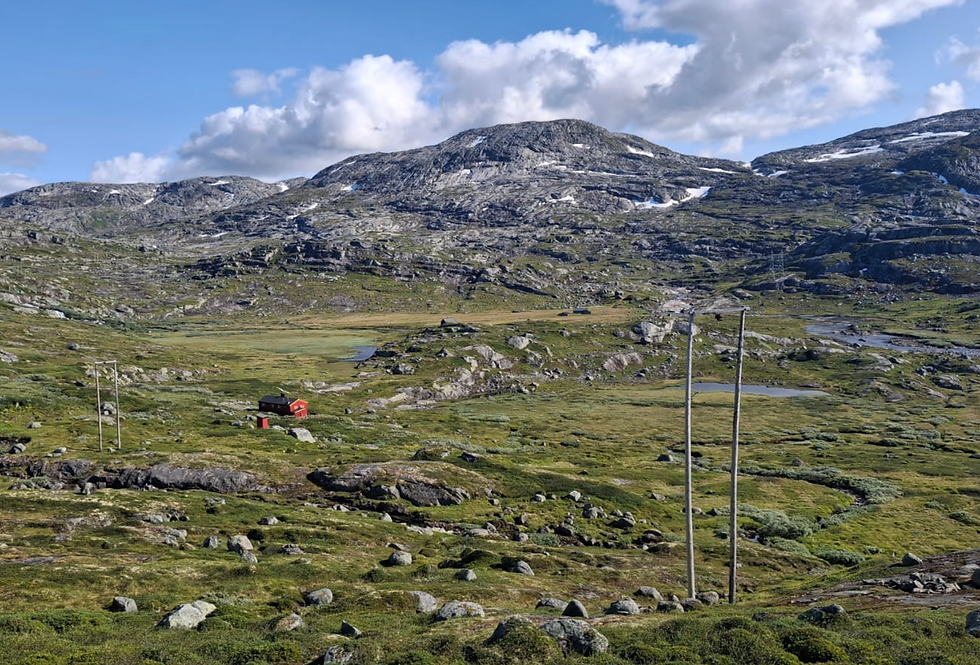
Norway was beautiful, but brutal. By day two, my knees screamed with each pedal stroke, and the vertiginous mountain climbs forced me into a mixture of pushing the bike followed by bursts of painful cycling. I couldn't find any indoor accommodation for three nights, instead having to power nap in a car park foyer, a church porch, and next to a lumber mill. Only the church porch retained any warmth from the day's bright sun. Norway is also dominated by the electric car. This meant very few petrol stations were left to restock supplies. And the few I found were often barren after 300 or so cyclists had raided them beforehand.

It was isolating, mentally draining and attritional.
Two highlights stand out for me: the first was cresting the highest mountain I'd ever cycled, at sunset and after bullying my knees into submission. The sense of accomplishment was magnificent. Second: my ice-cold wash in a mountain river. Absolutely freezing but so genuinely thrilling to clean off three days of grime and feel refreshed and human again.
In my current predicament, I didn't think I would make it to Checkpoint 1, let alone beyond. It seemed my race was coming to an abrupt end. At one point, I even waded thigh deep into a glacial lake, revelling as the stinging cold soothed my sore knees, with nothing but the sound of lapping water troubling my ears.
The final mountain climb towards the town of Flam was seven miles at an average 9% gradient, with some sections reaching a patella-busting 35%! On a fully loaded bike weighing close to 20kg, I knew this would be nothing but torture.
I tackled it at 5 am, after a three-hour nap on a park bench. My mind wandered into dark spaces on that relentless, mist-shrouded snake of tarmac as I slowly ground my way up. Spurred on by others (technically breaking rules), I somehow managed to summit amongst the snow and ice, and was greeted with a spectacular, sun-drenched fjord glittering below, albeit with a terrifying descent down winding hairpin roads too! This race was already pushing my bike handling skills past their limits.
I reached CP1 with 30 minutes to spare. After the mental battle of the last three days, I felt like I'd won the race. In fact, my journey of mishaps was so remarkable I made it onto the official podcast, detailing all the obstacles - some literally - that I'd overcome.
The second mistake:
My route across Norway and Sweden had been slightly avant-garde, following tracks that nobody else had chosen. I'd had to clamber over fallen trees and one stretch of 30 miles had taken almost four hours because of the gravelly terrain. Yet this was only a prelude to my awful routes in central Europe.
35 riders disembarked the ferry from Sweden to Poland, alongside myself. And within 10 minutes, I was utterly alone in the pouring rain, having taken an abrupt left away from everyone else. The next two days saw me battling through torrential rain, along cobble lanes, sandy forest tracks (where I crashed at 2 am, thankfully with only minor bruises) and through sleepy Polish villages. The constant damp caused saddle sores, although I fared better than one rider I met at a cafe, who'd just scratched from the race with open wounds, in total agony and unable to sit down.
My route was so remote that on my second night, as mist swirled up from the black river of asphalt, I came face to face with a large, dark, soggy wolf. Standing under a lamp about 10 metres ahead, perfectly framed by the light and the rising mist, it was both magical and terrifying. I felt a deep, primal fear clench inside my stomach as we stared at each other. What do you do when confronted with a wolf? I had no reference point for this moment. I just froze, transfixed. And then, just like that, it disappeared into the blackness of the woods, a swirl of mist in its wake, and a metaphorical swirl of doubt in my mind. When you can't see beyond the beam of your headlight, how do you know what is lurking in the gloom?
By now I had developed a routine; my knee pain was easing, and I was making up time - I clawed back 17 hours across Poland by riding through nights and only briefly sleeping in a bus stop and under a motorway bridge - getting myself back into the main group. But I hadn't anticipated the loneliness of the race.
I didn't see a single rider for almost 36 hours, despite knowing we were all in fairly close proximity. This loneliness was surprisingly difficult to deal with, even for this dedicated introvert. Only the mosquitoes seemed content to keep me company, feasting on any exposed skin like an all-you-can-eat wedding buffet, leaving one knee hideously swollen. Again.

As I crossed through Czechia into Slovakia, with temperatures now hitting 38 degrees and the Tatras Mountains looming ahead, my routing once again let me down. I spent 6.5 hours crawling along farm tracks for 20 miles one day, while other riders rapidly advanced along the main roads a few miles north. It was too late to divert, so I decided to commit.
The delay was only exacerbated by Parcours 2: a brutal climb of two 4,000ft mountains, under the full moon and in quick succession, followed by a truly dangerous gravel and rock path through gorges, before crawling over Slovakia's highest peak in the midday sun.
It was slow, exhausting, frustrating and at times inexplicably dangerous; conditions well beyond my skills, but with no alternative. I simply had to continue. I swore almost constantly, hurling obscenities at the silent pines or the pale moon, threw a rock in frustration, and sat demoralised outside a shop eating watermelon for far too long, conscious of time slipping away and my powerlessness to prevent it.

The result? I reached CP2 four hours outside the cutoff time. All my hard work in Poland largely obliterated by decisions made months ago on my sofa. I was exhausted, demoralised and thoroughly fed up with the race. It simply wasn't enjoyable, and my motivation had evaporated along with the constant sweat streaming off me. How would I ever complete this stupid challenge?
The final error:
Despite the failure, I decided to continue to Budapest before a final assessment of my situation and whether to try and get to Greece or cut my losses. For perspective, by this point almost 140 riders had already dropped out, some as far north as CP1. The TCR is a gruelling, personal battle, and I took comfort knowing I'd managed to reach Slovakia, past the halfway mark, even if it had done its best to break me (and this is ignoring the terrifyingly bad driving, like the oncoming logging lorry that swerved into my lane on a mountain pass, leaving me accepting my end as it squeezed inches past my shoulder at 60mph, a blur of diesel fumes and bark).
But my poor route choices struck again, and this time with gusto.
To cross the Tatras and reach Hungary, I took a remote farm track up into the mountains, hoping to cut distance by going over rather than around. Descending slowly through alpine valleys along bumpy gravel farm tracks - which I now despise - I emerged into a sunny, pine-lined paddock. Ahead were three enormous, bright white Tatras sheepdogs lying in the verdant grass.
Immediately, they jumped up, barking and bounding towards me at full speed. I began to slow, aware of the need to dismount the bike to show I was human (advice we'd been given before the start). But this felt counterintuitive with four massive dogs hurtling towards me, snarling with teeth bared.
I was too slow to dismount, and they surrounded me, growling, lunging and jumping up as I wobbled to a stop. I desperately tried to free my feet from my pedals but felt a sharp, painful grip on my left thigh. I saw the maw of a large white dog clamp into my leg. At that point, I genuinely thought I was about to be pulled into the dirt and mauled to shreds.
I yelped in pain and threw myself off the bike, sending a kick at another dog to my right, before somehow managing to get the bike between them and me. Now standing like a human, panting heavily and clutching the bike like a shield, they completely lost interest, nonchalantly bounding away back into the glade. I didn't linger and limped quickly into the treeline and out of sight, swearing profusely as my heart pounded inside my head and chest.
Looking down, blood oozed from seven tooth holes in my thigh. I quickly disinfected and washed the wound, but adrenaline and shock were beginning to impact me; I knew I needed to get off that mountain and into a pharmacy or hospital immediately.
It took four hours and 70 miles to get to the nearest town with a hospital, in blistering 40-degree heat. I felt sick from the effort and was worrying about rabies and other infections. But this was only the start of my troubles.

The hospital in Rimavska is very small. The nurses tried to help clean and dress my wound, but they couldn't comprehend my rabies vaccine requests, and no amount of miming or pleading could explain things. My Slovakian is zero and my Russian so minimal that I could only share my name and a love of dumplings. Phone signal was too poor for Google Translate, and there was no WiFi.
The embassy was out of hours, and the emergency line suggested my health insurance as the first option. They themselves were very helpful but couldn't magic up a vaccine from thin air, and with rabies, time is everything. My best bet was to get to Budapest, about 100 miles away across scorched farmland.
With my leg bandaged, I couldn't functionally cycle, so the next day a machine approximating the concept of a train, probably cobbled together somewhere in the USSR during Khrushchev's reign, clanked slowly along hot, dusty tracks, passing mile upon mile of barren fields until we stuttered into the city. I'd officially scratched from the race, potentially the first rider to ever DNF from a dog bite. It was bittersweet and frustrating, but I now had more time-sensitive issues of sourcing rabies and tetanus vaccinations.
It turns out this isn't as much of an emergency in Hungary either. The pharmacy suggested the district hospital, but when I went there they said I needed a different district hospital. On my third attempt, they said they didn't stock the drugs and to go to another place on Monday, which would be a full four days after the bite. I tried one more hospital the next morning, a Sunday, but they also didn't stock anything and suggested an office by the parliament, which turned out to house a lot of law firms (the wrong type of doctors) and the French ambassador. No medical facilities. And all of this was conducted in energy-sapping heat as Hungary suffered record-breaking temperatures. I limped around the city with my gammy leg and cycling shoes, a growing sense of despair and helplessness.
To complicate matters further, I was now flying to Greece at 6 am on Monday, on the only flight to Kalamata that week, to where my partner was due to meet me at the finish line (had things gone to plan). Against another clock and with limited options and language abilities, I opted to attend hospital in Greece, hoping four days was still within a safe timeline. However, my former nurse mother and epidemiology professor uncle had begun working behind the scenes and as I packed my bike into a hastily sourced box, an emergency medical service was procuring vaccines and doctors to administer them in my Budapest hotel. Never underestimate the panicked worry of a parent!
And so my race properly came to an end at the jaws of that mountain dog. An entirely unexpected, terrifying experience, even within the range of incidents the TCR proffered. While I felt disappointed I couldn't complete the full route, I learned a huge amount about myself and what I am capable of. I also finally grasped the magnitude of the emotional toll this had placed on me and my fiancé, whose quiet suffering, patience, and dedicated support over the past year were now my only source of comfort.
Once the cycling stopped, it was obvious just how much this event had come to dictate our lives. Now it was all over, with medical treatment my only priority, it was her voice down the phone that rendered me a sobbing husk outside a crumbling Soviet-era hospital in a forgotten Slovakian town; my emotions finally breaking after months of pressure. This was the first time in my life I've been left unable to communicate by raw emotion. Hearing her voice utterly broke my resolve, and in that moment I just wanted to be at home again, away from everything.
I had cycled over 3,000km in 11 days, roughly 2/3rds of the race, but discovered that I really don't enjoy racing. The constant pressure to push forward, be better, beat others, and the knowledge that you are against the clock; these things didn't resonate in a positive way.
I love exploring, seeing the world and experiencing it as it happens, something the TCR couldn't allow. It's a realisation that I derive more meaning from immersing myself in my surroundings. Perhaps that's why I made a career as a photographer.
I was searching for a purpose with TCR. It dominated my life, my partner's life, even our cat's life, for nine months, through the countless hours of training, route planning, sacrificing social and family life, and costing a small fortune to fund. The goal was almost bigger than the race itself, a way of trying to find a sense of belonging and intent. Instead, I've come away with a better idea of where to look for those things, and knowing what I value most in life. And those seven puncture wounds in my left leg.


Great read, and exposé of the tough nature and unexpected luck or bad luck that come your way. The winner of this race actually failed twice before glory, and he’s an elite. I hope you enjoyed the landscapes nevertheless. Excellent scriptive essay